
Optimizing Bid Analysis in Project Management: A Guide to AI-Powered Quote Tabulation
1. The challenges of bid leveling in the Contract Award phase
The Tendering and Contract Award phase represents a critical stage in construction project management. For architects, project managers, and quantity surveyors, bid tabulation involves analyzing the financial and technical proposals submitted by contractors following the publication of the Tender Price Document.
This exercise is particularly complex because each contractor structures their offer based on their own semantic habits or internal estimating software. Mapping the pricing lines of a masonry contractor, a carpenter, or an electrician to the initial Bill of Quantities (BoQ) requires dozens of hours of manual checking, data transcription, and ratio calculations on spreadsheets. This administrative burden reduces the time available for detailed technical analysis of the alternatives proposed by candidates.
2. The value of Computer Vision (OCR) and Semantic Analysis for reading quotes
Manual transcription of numerical values from PDF quote files is a major source of errors (transposed digits, typos on unit prices, shifted lines). Modern AI tools combine cutting-edge Optical Character Recognition (OCR) with Natural Language Processing (NLP).
The system instantly identifies the architecture of a technical or accounting document to isolate essential columns: item codes, work descriptions, units of measurement (linear meters, square feet, lump sum), calculated quantities, unit prices, and total amounts. Beyond simple data capture, the AI interprets the textual meaning of descriptions. For example, the phrase "Supply and install bituminous waterproofing system" used by a firm will be automatically correlated to the corresponding line in your BoQ labeled "Two-layer elastomeric membrane," ensuring perfect semantic alignment without human intervention.
3. Securing the Bid Analysis Report (BAR) and eliminating the risk of change orders
When evaluating bids on behalf of a client, the primary goal of the lead consultant is to designate the most economically advantageous offer (best value), not necessarily the lowest speculative bid. An abnormally low offer or one containing voluntary or involuntary pricing omissions inevitably leads to financial claims or change order requests from the very first site meeting.
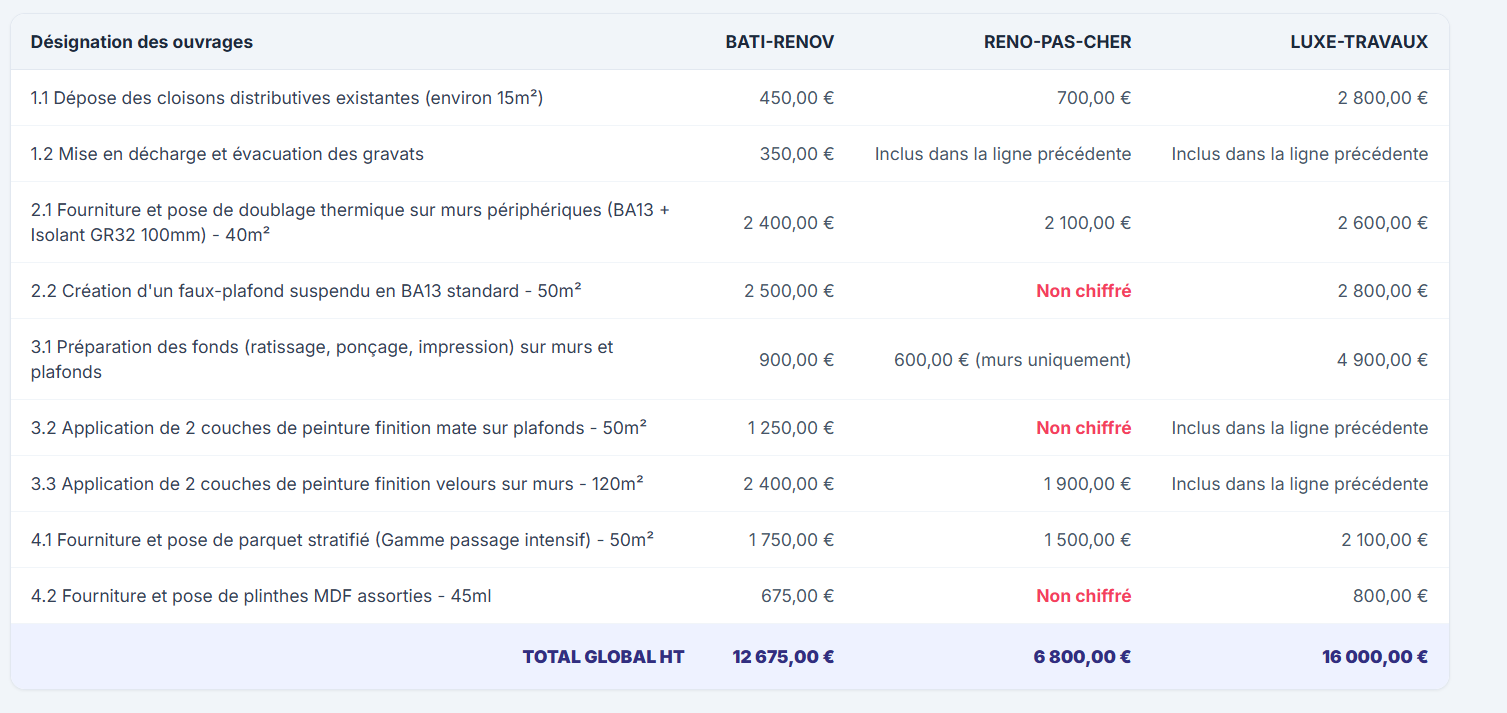
With Klysia's AI-powered quote comparator, all proposals are audited against your estimated budget. The global comparison table immediately highlights price anomalies (marginal rates too far from the market average) and quantity changes made by contractors. You can then produce a Bid Analysis Report (BAR) with indisputable mathematical rigor, allowing you to conduct technical negotiations on objective grounds and contractually secure future construction works.