Rationalizing Documentation in Project Management: Mastering Specs and BoQs in the Digital Era
1. Technical and Financial Correlation: The Pillar of Tender Management
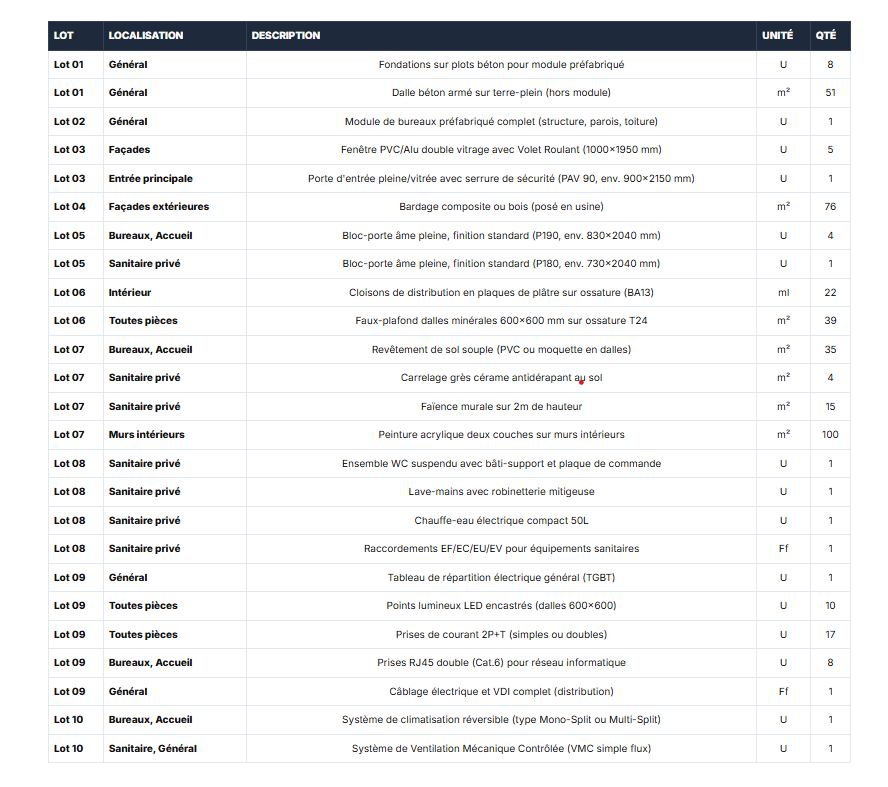
In the organization of Tender Documents, the Technical Specifications and the Bill of Quantities (BoQ) constitute the fundamental contractual duo upon which the mutual commitment of the client and contractors rests. While the former defines the nature, implementation, and performance of materials qualitatively, the latter materializes the economic equivalent through quantities and budget estimates.
The primary difficulty faced by quantity surveyors and project managers is the desynchronization of these two documents during intensive design phases. Changes in requirements requested by the client (for example, replacing a HVAC system or adjusting acoustic insulation performance) require an immediate rewrite in the specs, but also a rigorous adjustment of the line items in the financial framework. An omission or a poorly adjusted template creates a contractual loophole immediately exploited during the bid opening, generating major risks of cost overruns or claims during construction.
2. Automated Integration of Technical Standards and Legal Security
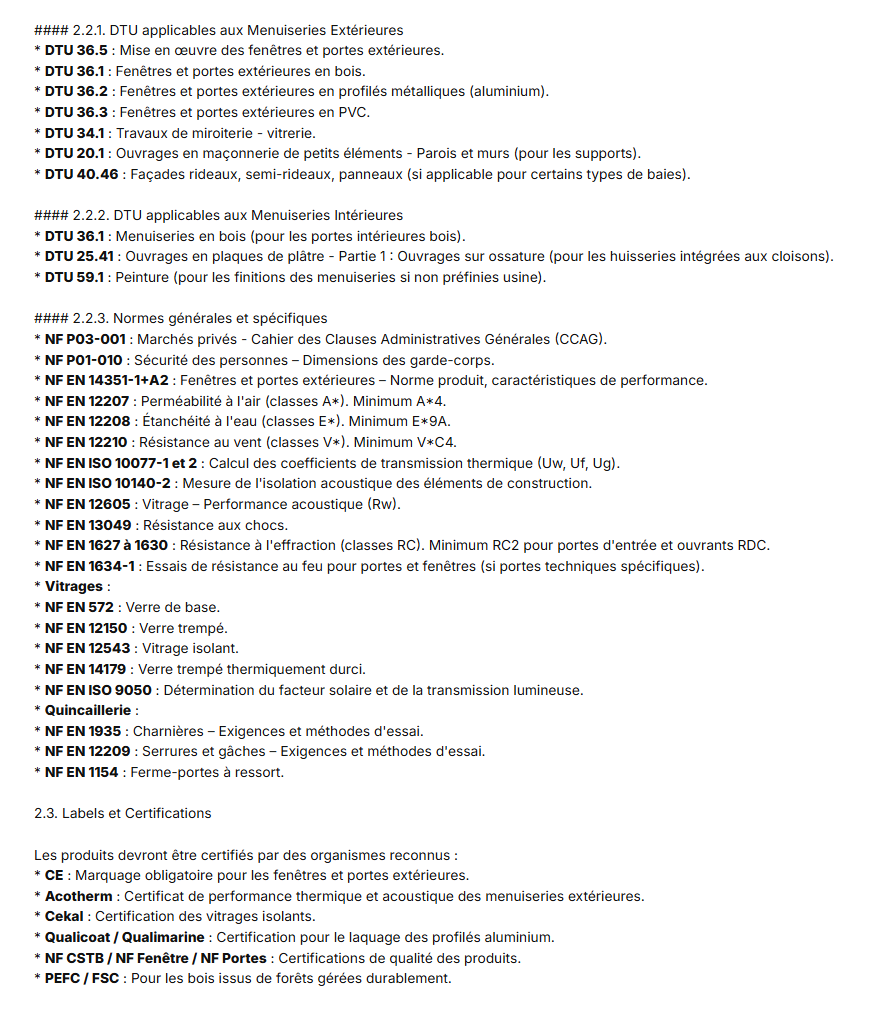
Building codes and standards serve as the "rules of the art" for insurance companies and courts. An obsolete technical description, referring to repealed standards or non-compliant installation techniques, directly triggers the professional indemnity of the designer. Following the permanent evolution of normative texts is a complex regulatory monitoring task for any architectural firm.
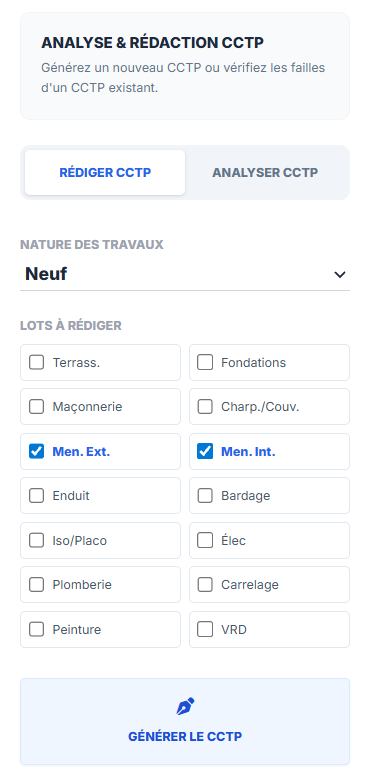
Utilizing an AI-assisted technical writing platform eliminates this risk of error. Domain-specific language models apply a logical structure based on up-to-date regulatory databases. When configuring a roofing or dry-lining package, the AI organically inserts implementation methodologies, substrate preparation checks, and geometric tolerances required by the latest codes and technical assessment bodies.
3. From Plan to Quantity: The Convergence of Computer Vision and Take-offs
Establishing quantities for trade packages (linear feet of baseboards, wall surfaces, door counts) is traditionally a repetitive chore involving manual measurement on a CAD file or drawing. Automated processing through graphical pattern recognition bridges the gap between visual data and the BoQ price framework. By analyzing the wall structure, document scale, and orientation of external openings, Klysia extracts essential dimensional data. The surveyor validates the detections and focuses on the essentials: adjusting unit rates, procurement strategy, and bid analysis.